- Details
 The Foundation has launched a project to develop a framework for a future phosphorus management plan for the Canadian portion of the binational Rainy-River-Lake of the Woods, with the support of a Contribution Agreement from Environment and Climate Change Canada (ECCC).
This project will scope and outline the key elements that would be required to develop a domestic phosphorus management plan collaboratively with relevant parties in the basin, once phosphorus targets are set by Canada domestically or as shared binational targets with Minnesota.
This work is timely now, to prepare for moving from research to action. In late June, the US EPA approved Minnesota’s phosphorus plan that sets phosphorus targets for each source to the Rainy River and Lake of the Woods. In Canada, ECCC completed public engagements last spring on potential phosphorus reduction scenarios based on its four-year science program (see the LOWWSF “What We Heard Report”).
- Details
 Over two hundred attended our five-part Ask and Expert webinar series this fall. Our lineup of experts had a wealth of knowledge and this was a great chance to connect directly with them. The webinars were recorded, so if you were not able to attend you can view the recordings at your leisure.
- Details
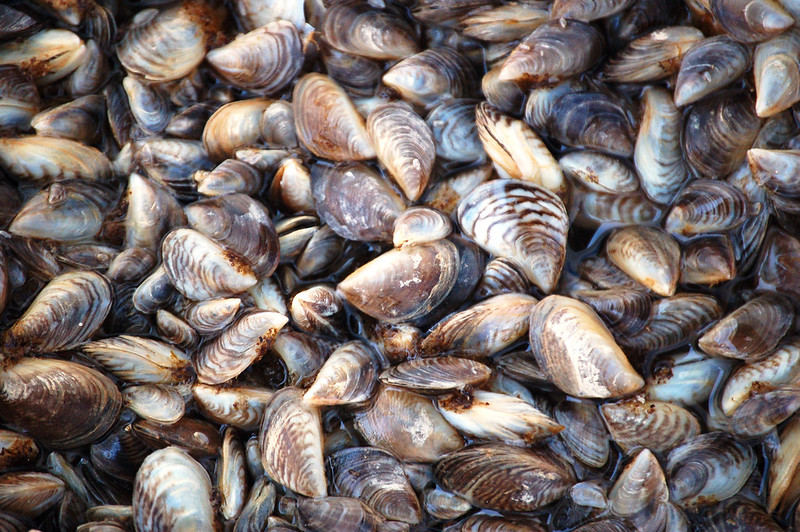 Disappointing news. Zebra mussel larvae have been confirmed in Rainy Lake by the Minnesota Department of Natural Resources (MNDNR). The larvae were found in four of five water samples taken in July 2021, suggesting that there is a reproducing population in the lake according to MNDNR. This follows on an unconfirmed report of larvae in 2020 by a member of the public. Locations of adult reproductive colonies have not yet been located or confirmed. Rainy Lake straddles the Ontario-Minnesota border and flows downstream via the Rainy River to Lake of the Woods.
This follows equally concerning confirmations by MN DNR in 2019 and 2020 of zebra mussel larvae at several sites in the southern portion of Lake of the Woods.
- Details
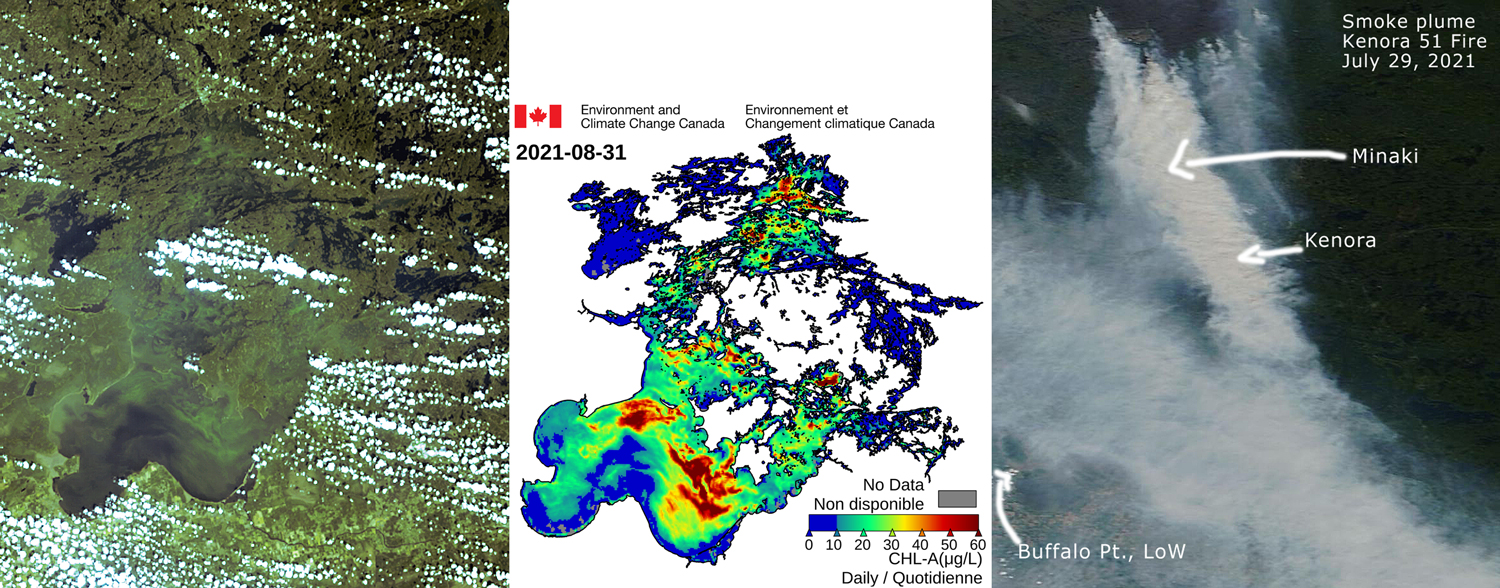 The seasonal algae bloom on Lake of the Woods is underway and has progressed up into the north end of the lake, as shown in the satellite image and associated derived chlorophyll-a data for August 31.
For much of the summer, it seemed like a "light year" for algae blooms, but blooms began to develop in mid-to late August. The low blooms in much of the mid-summer may perhaps be due to the low water and low flows from the nutrient-rich southern basin of Lake of the Woods, or perhaps lower light conditions due to the intense smoke that blanketed the lake throughout July and into the first week of August. The smoke conditions also likely limited the days for which the satellite tools could generate good chlorophyll-a estimates. The satellite tools, developed by Dr. Caren Binding at Environment and Climate Change Canada, hold much promise for long-term monitoring of trends in algae bloom intensity and severity.
- Details
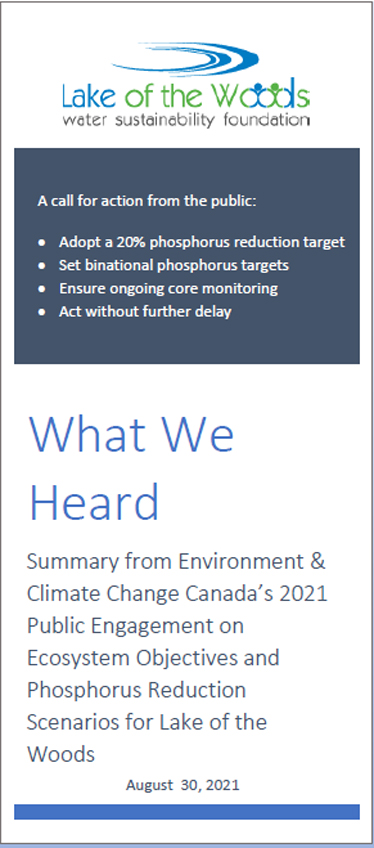 LOWWSF has released a report summarizing what we heard from the public during engagement sessions with Environment and Climate Change Canada on its set of proposed lake ecosystem objectives and potential phosphorus reduction scenarios to improve water quality for Lake of the Woods. Hundreds participated in ten webinars and online via ECCC's Lake of the Woods engagement website. The messages were clear and a call to action -- "get on with it":
- Adopt a 20% phosphorus reduction target
- Set binational phosphorus targets
- Ensure ongoing core monitoring
- Act without further delay
- Details
by Bev Clark, for the Lake of the Woods Water Sustainability Foundation
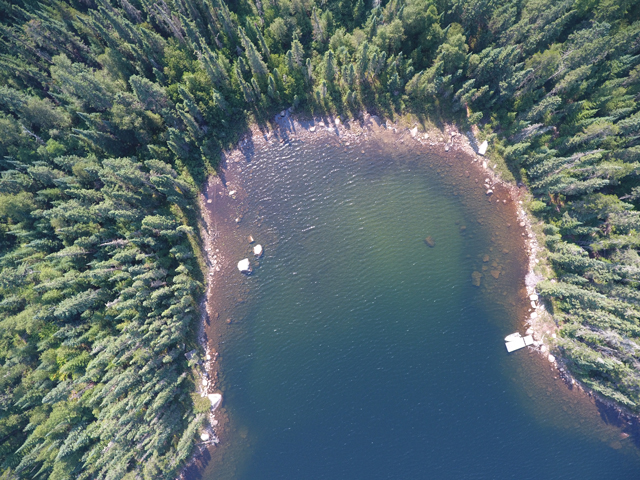 If you are concerned about algal blooms in Lake of the Woods or algal blooms anywhere for that matter, then you will hear a great deal about phosphorus concentrations and phosphorus loads. The difference is almost straightforward.
In this article, Bev demystifies the talk about phosphorus and its relationship to algae and how it relates to the types of lakes in our region, ranging from the ultra-clear waters of Lake 224 pictured here to the algae laden green waters of the south end of Lake of the Woods
(Lake 224 photo courtesy of the IISD Experimental Lakes Area)
- Details
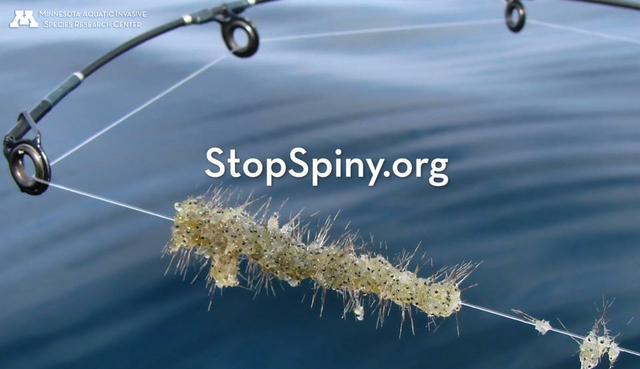 Spiny waterfleas are small aquatic predators native to Eurasia. The first report of spiny waterfleas in North America was in Lake Ontario in 1982 and was introduced to the Great Lakes in ballast water from ocean-going ships. “Spiny” is a species of zooplankton – small animals that rely on water currents and wind to move long distances. They prefer large, deep, clear lakes, but can also be found in shallower waters.
- Details
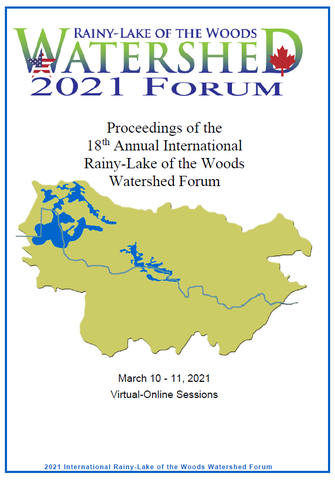 All eyes focused “virtually” on our watershed and lakes at the 18th annual International Rainy-Lake of the Woods Watershed Forum, held on March 10 and 11. Over 180 participated – a record attendance, with 21 presentations and Q&A sessions organized into theme groups of Water Governance, Aquatic Invasive Species, Nutrients, Canadian Phosphorus Options, Regulation, and Monitoring.
Priscilla Simard and Mona Gordon, Knowledge Keepers with the Women’s Council of Grand Council Treaty #3 opened the Forum with a prayer and ceremony honouring Nibi (water). Their thoughtful words, reflecting on the need to work together to respect and protect Nibi in our watershed, got our meetings and discussions started in a good way. Welcome addresses focusing on the strong binational collaboration in our watershed were provided by Consul General Ariel Delouya, from the Canadian Consulate in Minneapolis and Consul Brian Koontz, from the U.S. Consulate in Winnipeg.